Well, there is no doubt the economic collapse will hit in the not too distant future. Most states are in financial trouble. Politicians still are not dealing with our problems.
Our southern border is wide open for Mexiscum to invade us at will. Just who are these Mexicans? Nice, hardworking folks who are just looking for a break?

Well, old habits die hard I guess.

Above image is an Acapulco murder victim.

Another view. Note the penis placed in the left hand.
We already have ten to twenty million of these "people" in the U.S. Are Illegals really committing serious crimes?
Link
- In Los Angeles, 95% of some 1,500 outstanding warrants for homicides are for illegal aliens. About 67% of the 17,000 outstanding fugitive felony warrants are for illegal aliens.
- There are currently over 400,000 unaccounted for illegal alien criminals with outstanding deportation orders. At least one fourth of these are hard core criminals.
- 80,000 to 100,000 illegal aliens who have been convicted of serious crimes are walking the streets. Based on studies they will commit an average of 13 serious crimes per perpetrator.
- Illegal aliens are involved in criminal activities at a rate that is 2-5 times their representative proportion of the population.
- In 1980, our Federal and state facilities held fewer than 9,000 criminal aliens but at the end of 2003, approximately 267,000 illegal aliens were incarcerated in U.S. correctional facilities at a cost of about $6.8 billion per year.
- At least 4.5 million pounds of cocaine with a street value of at least $72 billion is smuggled across the southern border every year. ..
- 56% of illegal aliens charged with a reentry offense had previously been convicted on at least 5 prior occasions.
- Illegal aliens charged with unlawful reentry had the most extensive criminal histories. 90% had been previously arrested. Of those with a prior arrest, 50% had been arrested for violent or drug-related felonies.
- Illegal aliens commit between 700,000 to 1,289,000 or more crimes per year.
- Illegal aliens commit at least 2,158 murders each year – a number that represents three times greater participation than their proportion of the population.
- Illegal alien sexual predators commit an estimated 130,909 sexual crimes each year.
- There may be as many as 240,000 illegal alien sex offenders circulating throughout America. Based on studies, they will commit an average of 8 sex crimes per perpetrator before being caught.
- Nearly 63% of illegal alien sex offenders had been deported on another offense prior to committing the sex crime.
- Only 2% of the illegal alien sex offenders in one study had no history of criminal behavior, beyond crossing the border illegally.
- In Operation Predator, ICE arrested and deported 6,085 illegal alien pedophiles. Some studies suggest each pedophile molests average of 148 children. If so, that could be as many as 900,580 victims.
- Nobody knows how big the Sex Slave problem is but it is enormous.
- The very brutal MS-13 gang has over 15,000 members and associates in at least 115 different cliques in 33 states.
- The overall financial impact of illegal alien crimes is estimated at between $14.4 and $81 billion or more per year. Factor in the crime as a result of the cocaine and other drugs being smuggled in and the number may reach $150 billion per year.
Still think illegal immigration is a "victimless crime" and we don't need to control our borders? Remember, about 60% of the crimes being committed are by illegal aliens who were previously deported."
So what great cultural and religious benefit can we gain from them? Well, there is a growing religious movement down there. (Link to below)
WARNING!
The views expressed in FMSO publications and reports are those of the authors and do not necessarily represent the official policy or position of the Department of the Army, Department of Defense, or the U.S. Government.
The Death Cult of the Drug Lords Mexico’s Patron Saint of Crime, Criminals, and the Dispossessed
by Kevin Freese,
Foreign Military Studies Office, Fort Leavenworth, KS.
Table of Contents
Introduction
Executive Summary
Sources
Terms and Concepts
Death in Mexican Culture
Epithets and Aliases
The Power of Color
Iconography
Common Offerings
Death’s Collects
Objectives of Prayer
The Origin and Spread of the Cult
The Goddess of Tepito
The Lord of the Rings
Santa Muerte Witnesses Violent Crimes
Prisoners Pray to Santa Muerte
The Skeleton in the Family Closet Was Santa Muerte
Criminals Carry Accoutrements of Santa Muerte
Santa Muerte Has Following in Major Criminal Organizations
Santa Muerte on the U.S. Border
The Patron Saint of Crime
Conclusion
Table of Figures
Figure 1 Santa Muerte in the Zocalo, Mexico City
Figure 2 La Catrina Calavera
Figure 3 Imprisoned Cult Practitioner with Tattooed Santa Muerte and Tattooed Amulet
Figure 4 A Prisoner's Tattoo of Santa Muerte
Figure 5 Santa Muerte devotee displays amulet
Figure 6 Statues of Santa Muerte
Figure 7 Table of Santa Muerte Rituals
Figure 8 Mictlantecuhtli
Figure 9 Mictlantecuhtli
Figure 10 Mictecacíhuatl
Figure 11 Oyá
Figure 12 Yewá
Figure 13 Maman Brigitte
Figure 14 Shrine to Maximón
Figure 15 Aerial Photograph of Tepito Market
Figure 16 David Romo Guillén
Figure 17 A Worshipper inside the Santa Muerte National Sanctuary
Figure 18 David Romo Guillén
Figure 19 Martínez’ Tattoos
Figure 20 Ramirez’ Tattoos
Figure 21 Pérez’ Tattoo
Introduction
In Tony Scott’s 2004 action film Man on Fire, the haunted protagonist John Creasy (played by Denzel Washington) seeks revenge against a gang of kidnappers that, he believes, has murdered a little girl he was hired to protect. In one scene, as Creasy revisits the actual location of the kidnapping, Reforma journalist Mariana (played by Rachel Ticotin) picks up an amulet off the ground and says to him, “It’s Santa Muerte. Death worship. The religion of La Hermandad [The name of the kidnapping gang in the movie]. There’s a curse on you.”[1] The statement was intended as a subtle reminder of the notorious Mexican kidnapper known as El Mochaorejas [literally, “the ear-chopper”], who was a devotee of Santa Muerte [Holy Death], a corruption (some would say perversion) of the cult of the Blessed Virgin in Mexican Catholicism.[2] The film received mixed reviews and it appears that the allusion escaped the comprehension of much of the audience. Nevertheless, it offers an interesting glimpse, from the point-of-view of Hollywood cinema, into an intriguing facet of Mexican organized crime. Because of the underground nature of organized crime, it transcends the boundaries of conventional business and emerges as a distinct subculture, indeed a number of subcultures, complete with all of the various accoutrements thereof. This is, perhaps, no more clearly evident than in the cult of Santa Muerte.
Executive Summary
The Santa Muerte cult could probably best be described as a set of ritual practices offered on behalf a supernatural personification of death. The personification is female, probably because the Spanish word for death, muerte, is feminine and possibly also because this personification is a sort of counterpart to the Virgin of Guadalupe. To believers, the entity exists within the context of Catholic theology and is comparable to other purely supernatural beings, namely archangels. The cult involves prayers, rituals, and offerings, which are given directly to Santa Muerte in expectation of and tailored to the fulfillment of specific requests. These bear some resemblance to other traditions. The origin of the cult is uncertain; it has only been expanding recently. The cult appears to be closely associated with crime, criminals, and those whose lives are directly affected by crime. Criminals seem to identify with Santa Muerte and call upon the saint for protection and power, even when committing crimes. They will adorn themselves with her paraphernalia and render her respect that they do not give to other spiritual entities.
 Figure 1 Santa Muerte in the Zocalo, Mexico City[3]
Sources
There is, at least in English, a notable lack of academic literature about the Santa Muerte cult. However, due to its macabre charm, the cult and its devotees have received considerable attention in Mexican, Latin American, U.S., and even international news media. It also appears in Mexican government press bulletins, ranging from state-funded Anthropological studies of the cult itself to public arrest records concerning individuals connected to the cult. There are also a few internet sites maintained by cult adherents as well as published handbooks of cult rituals and traditions that are used by cult practitioners. The cult has been touched upon in anthropological studies of the symbol of death in Mexico culture. Although most of sources are in Spanish language, some have English translations.
Terms and Concepts
The term “cult” generally is used to refer to the people and practices associated with Santa Muerte. This can be attributed, in part, to the fact that Spanish-language sources consistently use the cognate “culto”. The term’s use does not entail the pejorative meaning of a strictly controlled, fringe religious group, led by a charismatic leader. Although the Santa Muerte cult certainly appears to be fringe, it does not appear to be a formal or controlled group, at least yet. Instead, the term cult really applies to the series of rituals and practices associated with religious worship, i.e. the physical as opposed to cognitive and/or mystical dimension of worship. In this sense, it is comparable to the cult of the Blessed Virgin in Christianity. Similarly, persons who worship Santa Muerte cannot accurately be called “members” of the cult, since there is no formalized or exclusive membership. The terms “devotee”, “adherent”, and “practitioner” seem to be more accurate and appropriate. There is also some theological and linguistic inconsistency over the term “saint”. Santa Muerte is certainly not a saint officially recognized by the Roman Catholic Church or, indeed, any other mainstream branch of Christianity. Nevertheless, other than worshiping her, her devotees do not appear to espouse any theological doctrine that greatly diverges from mainstream Catholicism. Many if not most practitioners seem to consider themselves to be, more or less, good, practicing Catholics. Unlike a conventional saint, Santa Muerte definitely appears to be the object of worship rather than a simple intercessor, which is a significant divergence from Catholic doctrine, although the actual practice is not unheard of in the mysteries associated with other Catholic saint traditions, at least unofficially. The name itself is easily confused in translation. Some have translated Santa Muerte into English as “Saint Death”. Although this conveys the concept accurately, the correct literal translation is “Sacred Death” or “Holy Death”.[4]
Death in Mexican Culture
The image of death is pervasive in many aspects of Mexican culture. Probably the most widely known manifestation of this is the feast of the Day of the Dead on the second of November, when Mexicans frequently parade skeletal images and render honors to their deceased loved ones. Another example is the image of the Catrina Calavera, a skeleton in a wedding dress that was popularized in the satirical works of the late nineteenth/early twentieth century artist José Guadalupe Posada.[5] Such customs can be easily misunderstood by outsiders; it might even be tempting to confuse the Santa Muerte with these other cultural traditions.
 Figure 2 La Catrina Calavera[6]
To do so would be erroneous. Although Santa Muerte is venerated on the Day of the Dead, it appears to be a distinct phenomenon emerging from a separate tradition. The fact is, Santa Muerte probably has more in common with the roguish saint Jesus Malverde, who is sometimes glorified in Mexico’s famous (arguably infamous) narcocorridos, or Mexican drug-ballads, and who is worshipped by Mexican drug traffickers as a protector saint, especially in the Mexican State of Sinaloa.[7] There may also be influence or inspiration from Catholic-African synchronistic religious practices, such as Haitian Voodoo, Cuban Santeria, or Brazilian Palo Mayombe, with some witchcraft thrown into the mix.
Epithets and Aliases
A perusal through Mexico’s most wanted reveals a veritable plethora of epithets and nicknames. Devotees of Santa Muerte have not disdained to share this practice with her, although it should be observed that the nicknames themselves are not necessarily limited to Santa Muerte as an object of worship but are generally used by Mexicans in reference to Death personified.[8] Some of the nicknames are simply variations, including Santísima Muerte [Most Holy Death or Very Holy Death], Sagrada Muerte [Sacred Death], Querida Muerte [Beloved Death], or, in Argentina, San la Muerte [Saint Death – a Masculine variation].[9] Other labels suggest mystical interpretations of her nature, role, and/or relationship to the devotee, such as Poderosa Señora [Powerful Lady][10], La Comadre [The Co-Mother – possibly a pun on “Co-Redeemer”][11], La Madrina [The Godmother – notably used in Mexican prisons], or La Hermana [The Sister].[12]
At least two nicknames refer to her as Saint Martha: Santa Marta [Saint Martha][13] and Martita [Little Martha].[14] The theory is that Santa Muerte represents the pious soul of Saint Martha. However, because of the obvious phonetic similarities,[15] simple corruption of the vowel sound (i.e. crasis) should not be ruled out as a plausible explanation.
The commonest forms of nickname appear to be physical descriptors or puns thereon. These include La Santa Niña Blanca [The Holy White Girl],[16] La Niña [The Girl],[17] La Bonita [The Pretty Girl],[18] La Flaquita [The Little Skinny Girl],[19] La Flaca [The Skinny Girl],[20] and Negrita [The Little Black Girl].[21]
The nicknames are interesting because they suggest a sort of reverent irreverence, using familiar and demeaning, or at least diminutive, names to enhance the sacredness and sense of power of Santa Muerte. They are also reminiscent of the darkly comic tradition of the Catrina Calavera. Finally, they betray a custom of the followers themselves. Although the use of aliases and nicknames is common in Mexico, it is particularly common among criminals. The very fact that there are so many nicknames suggests that criminals view Santa Muerte, consciously or unconsciously, as one of their own.
The Power of Color
Color itself seems to be very important in the Santa Muerte cult. Statues dressed in particular colors represent certain powers or attributes. Similarly, when a devotee lights a candle, or a combination of candles, to Santa Muerte, the color of the candle used corresponds to the desired result. Gold represents economic power, success, and money. Devotees maintain that this color is suited for businessmen and merchants. The natural bone color is believed to promote peace and harmony, particularly among neighbors, and is intended for homes and businesses. The color red is associated with love and passion, as well as emotional stability; it is recommended for couples. White represents purification and defense against negative energy, particularly in situations when there is envy among relatives. Blue is used to help improve mental concentration. Green is the color used to help people with legal problems or matters of justice; it is the color used most often by lawyers. Yellow is the color used for healing from diseases. It is frequently used by drug addicts and alcoholics who are undergoing rehabilitation. The color purple also is purported to bring health. Black represents complete protection, particularly against black magic and hostile spirits associated with Santeria, Palo Mayombe, or voodoo. Black also is the color used by sorcerers to cause harm to their enemies.[22]
The color symbolism in the Santa Muerte is distinct from other esoteric practices. Although other religious/occult traditions use candles in ceremonies, especially in Afro-Caribbean traditions, the association of a particular color of candle with a particular intention seems more akin to the practices of European occultists, especially Wiccans. There is even some direct correspondence in certain colors. However, this is not consistent, suggesting possible influence but not direct heritage. Furthermore, the parallel is limited specifically to the color of candles, not the vestments of the statuary.[23] Finally, the functions of the colors themselves consistently although not without exception, have applications for crime: lust, power, help with legal power, cursing enemies, defending against curses from enemies, and help with drug addiction. Although these benefits may have applications for any follower, they would particularly appeal to those who live in a world of drugs and crime.
Other aspects of Santa Muerte iconography have significance as well. Devotees of the saint interpret the sickle, often carried in the right hand, to represent justice, while the globe, often in the left hand, represents dominion over the world. Sometimes, an image of Santa Muerte is holding an ear of corn, which apparently represents generosity.[24] Such symbols are very useful for identifying cult iconography. Whereas the image of the Grim Reaper is a relatively common image and in and of itself does not signify any cult association, when the Death figure is displayed with the ear of corn, a crown, or possibly a globe or scale, it does indicate a Santa Muerte association. The icon itself can come in many forms. Devotees wear small amulets and medals, commonly called milagros in Mexico. They also keep statues and statuettes for offerings. These practices seem to be more or less reminiscent of Catholic saint worship. However, unlike the case with mainstream Catholic practices, devotees of Santa Muerte, particularly incarcerated cult practitioners, will sometimes take the additional step of having the icon tattooed onto their bodies.[25] This has been referred to as an offering of skin.[26] In some cases, this is an image of Santa Muerte; in others, it seems to be the entire amulet that is tattooed.[27] Such an application is not merely innovative; it is telling. While tattooing has become a mainstream practice in much of North America even among the middle class, in Latin America, tattoos remain the hallmarks of criminal affiliation and imprisonment.
Iconography
Figure 3 Imprisoned Cult Practitioner with Tattooed Santa Muerte and Tattooed Amulet[28]Figure 4 A Prisoner's Tattoo of Santa Muerte[29] Figure 5 Santa Muerte devotee displays amulet[30] Figure 6 Statues of Santa Muerte[31] Common Offerings
The beliefs associated with the cult appear to be relatively consistent. Santa Muerte devotees attend to their practice by lighting candles and leaving offerings while reciting prayers, often ritual prayers, in hopes of receiving favors. Such offerings draw upon Christian symbolism. Tequila, for example is a representation of the chalice of Christ. An apple represents original sin.[32] There appears to be a tradition about what sorts of offerings are appropriate. Santa Muerte has been described as jealous about what offerings are given to her.[33] However, gifts that are somehow personal or in keeping with other religious offerings are considered acceptable.[34] Offerings are not given willy-nilly; there is a recipe and ritual associated with each offering, so as to ensure the granting of the desired effect.[35]
Appropriate offerings can include money, flowers, candy, alcohol, tobacco, fruits, water, bread, or incense. Money is a preferred offering, particularly in businesses, when the profits from the first sale of the day are given. Flowers of various types are acceptable, but should be fresh. White roses are normally used for healing or health and are considered to be the preferred form. Red roses are used for love. Candy offerings are also a matter of personal preference, although chocolate is common, particularly for love, and honey is considered to be a standard offering. Wines and liquors are common offerings, especially tequila, rum, and sherry, as well as dark beer; these are usually served in glass bottles or cups but not plastic. Cigars and cigarettes are among the most preferred offerings; they should be lit. Smoke blown over the image is used to purify the altar. Fresh fruit is also used as an offering. Red apples are the commonest offering but other fruits are often left. The color of the fruit can correspond to the benefit sought, in a way comparable to candles. Water is considered to be a crucial offering and should be clear and still, preferably from a tap. Bread is also offered frequently, as is incense. In the case of incense, different types of incense are used for different ends, in varieties that are sold by vendors of esoteric commodities.[36]
Death’s Collects
Just as the offerings are presented in a formulaic manner, the prayers themselves are often highly structured, in a format that resembles Christian collects. Some prayers even refer to the Trinity: “In the name of the Father, the Son, and the Holy Spirit, made of pure light, I implore you to grant me the favors I should request of you until the final day, hour, and moment at which your divine majesty orders me to come before your presence. Desired Death of my heart, do not abandon me from your protection.”[37]
Similarities also manifest in the attempt at comprehensiveness that occurs in prayers. This occurs in protection prayers: “Oh, Most Santa Muerte, I call upon you so that, through your image, you may free me from all dangers, whether [these dangers] are physical or from witchcraft, and that through this sacred flame you might purify my body from all charms and curses and that you also bring love, peace, and abundance. So be it.” It also occurs in prayers for success and wealth: “Desired Death of my heart, do not abandon me from [your] protection and I ask your blessing on this devotee of yours and that also you bring success, bring personal and economic prosperity, and take from me all natural or caused disease. So be it.”[38] Of further interest, the ending “so be it” is a translation of the traditional Christian prayer ending, “Amen”.
The formula is also applied to curses: “Death of my heart, do not abandon me from your protection and do not permit (name of enemy) a single moment of peace. Molest him each moment, mortify him and worry him so that he always thinks about me and does what I want.”[39]
Objectives of Prayer
Whereas the form of offerings and prayers offers insight into the cults methods, it is the content of those offerings and prayers, which offers insight into the objectives of cult practitioners. The closest thing to a handbook for Santa Muerte practitioners is Juan Ambrosio’s La Santa Muerte Biografía y Culto: Ventiséis rituales personales para conseguir salud, dinero y amor, which is, effectively, a recipe book for Santa Muerte rituals. The book contains twenty-six rituals:
#
Ritual
Translation
1
El poder de las tres muertes
The power of the three deaths
2
La mano de la muerte: para que se cumplan nuestros más caros anhelos
The hand of death: to fulfill the most dear yearnings
3
Ritual para alejar a las malas amistades de nuestra pareja
Ritual to send away bad friendships from our partner
4
Ritual contra la magia negra
Ritual against black magic
5
Ritual para alejar un amante
Ritual to send away a lover
6
Ritual para alejar a los novios
Ritual to send away fiancés
7
Para que tu pareja te ayude económicamente
So that your partner helps you economically
8
Para que no entren chismes o nertía negative en tu casa o negocio
So that gossip or negative energy does not enter your home or business
9
Velación a la Santa Muerte para que nos paguen una deuda
Prayer to Santa Muerte so that a debt is paid to us
10
Ritual para socorrer a quienes estan presos
Ritual to comfort those in prison
11
La balanza de la justicia: ritual para resolver problemas legales
The balance of justice: ritual to resolve legal problems
12
Ritual para quienes serán sometidos a una intervención quirúrgica
Ritual for those who will undergo surgery
13
Bálsamo de la Santa Muerte para que marche bien tu negocio
Balsam of Santa Muerte so that your business does well
14
Ritual para incrementar las ventas en tu negocio
Ritual to increase sales in your business
15
Ritual para limpiar tu dinero
Ritual to clean your money
16
Tres recetas sencillas para obtener dinero
Three simple prescriptions to obtain money
17
Ritual del chocolate para dominar al amante, novio o esposo
Ritual of chocolate to dominate your lover, fiancé or spouse
18
Baño de la Santa Muerte para el amor
Bath of Santa Muerte for love
19
Novena para ligar a una persona
Novena to bind a person
20
Para un amor difícil
For a difficult love
21
Amuleto de la Santa Muerte para tu automóvil
Amulet of Santa Muerte for your automobile (used for protection when buying a vehicle, when suffering frequent vehicle problems, or suffering accidents, or when vehicle is jinxed)
22
Para retirar al mal vecino
To send away a bad neighbor
23
Ritual para que se alejen las malas amistades de nuestros hijos
Ritual to send away bad friends of your children
24
Otro ritual para alejar malas amistades
Another Ritual to send away bad friends
25
Velación a la Santa Muerte para que nuestros hijos no abandonen los estudios
Prayer to Santa Muerte so that our children do not abandon their studies
26
Velación para que un matrimonio no se realice
Prayer so that a marriage does not happen
Figure 7 Table of Santa Muerte Rituals
The subject of these rituals include: a general prayer for power, a general wish, six rituals to drive away undesired persons, five rituals for improved business profit, one to ward against black magic, one ritual to ensure a debt is paid, two prayers to help prisoners or people with legal problems, one ritual to help someone undergoing surgery, two spells to protect a home, business, or vehicle, one ritual to keep children in school, one prayer to bind a person, three love spells, and one spell to stop a marriage. These rituals resemble the pagan concept of do ut des, or giving a favor in hopes that another favor might be given (lit. “I give so that you might give”) which, although present in Christianity, is not standard practice. Furthermore, most of the objectives of these prayers would be incompatible with Christian doctrine, which explains why an alternative saint is needed. In this sense, Santa Muerte is more akin to primitive Western polytheistic adorations. It also resembles modern esoteric practices such as Voodoo, Santeria, Palo Mayombe, and Wicca.
The Origin and Spread of the Cult
The origin of the Santa Muerte cult is as mysterious and controversial as the nature of the cult itself. Some devotees assert that the death cult has existed in Mexico for as many as three millennia, having been handed down from the progenitors of the Maya, Zapoteco, Totonaca, and other indigenous groups until it became widespread under the Mexicas and the Aztecs.[40] According to the theory, the figure now represented by Santa Muerte may actually be the legacy of Aztec devotions to Mictlantecuhtli and Mictecacíhuatl, the god and goddess of death respectively, rulers of the shadowy underworld realm of Mictlán. They were traditionally portrayed as skeletons or persons with skeletal heads. Offerings to them included the skins of human sacrifices.[41] Both allegedly ate the dead. They were worshipped by those seeking the power of death. Their temple was located in the ancient ceremonial center of the city Tenochtitlan (modern Mexico City). The name of the district was Tlalxico.[42]

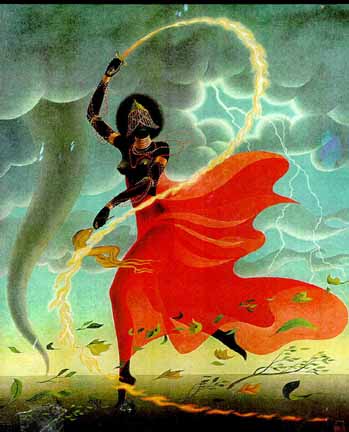
Figure 8 Mictlantecuhtli[43] Figure 9 Mictlantecuhtli[44] Figure 10 Mictecacíhuatl[45] Another theory is that the cult came from Yoruba traditions, being handed down from African slaves brought to the Americas and transmitted to Mexico through, or parallel to, the Cuban tradition of Santeria, the Brazilian tradition of Palo Mayombe, or the Haitian tradition of Voodoo. All of these practices are synchronistic traditions that emerged from the interaction between African animistic and polytheistic traditions with traditional saint-worship in Catholic Christianity. According to this theory, Santa Muerte is actually a variation of the Santeria orishas (spiritual entities) Oyá, goddess of storms, and/or Yewá, goddess of the underworld,[46] who, according to Santeria beliefs, brings bodies of the dead to Oyá.[47] She could also be a variation of Centella Endoki AKA Mama Wanga, ruler of cemeteries, who is a Palo Mayombe version of the Santeria Oyá. Finally, the tradition could trace back to the Voodoo entity Maman Brigitte, who is also a counterpart to Oyá and Centella Endoki.[48] A third theory is that Santa Muerte appeared in a vision to a nineteenth century witchdoctor (brujo chamán) in the village of Orizaba, Veracruz and ordered the creation of the cult.[49]

 Figure 13 Maman Brigitte[52]
Such theories may be ill founded, according to Elsa Malvido Miranda, a researcher for the Historical Studies Directorate (DEH) (Dirección de Estudios Históricos) of the Mexican National Anthropology and History Institute (INAH) (Instituto Nacional de Antropología e Historia). Malvido argues that the cult can be traced back to mediaeval Europe. Especially during times of plague and epidemic, people would offer devotions to skeletal figures, which were even associated with miraculous cures. According to Fernán Pavía Farrera, a historian from Tuxtla Gutiérrez, Chiapas, such traditions may have spread to the Americas through the cult of the Spanish Saint Pascual Bailon (also called San Pascualito and Santo de los Pobres), who lived from 17 May 1540 until 17 May 1592. San Pascualito reportedly appeared in visions to indigenous peoples in Valle de Guatemala during a plague in 1601, for which he was attributed with healing miracles. He became known as a “protector of the Indians” [protector de los indios]. His image was venerated in the form of a crowned skeleton.[53]
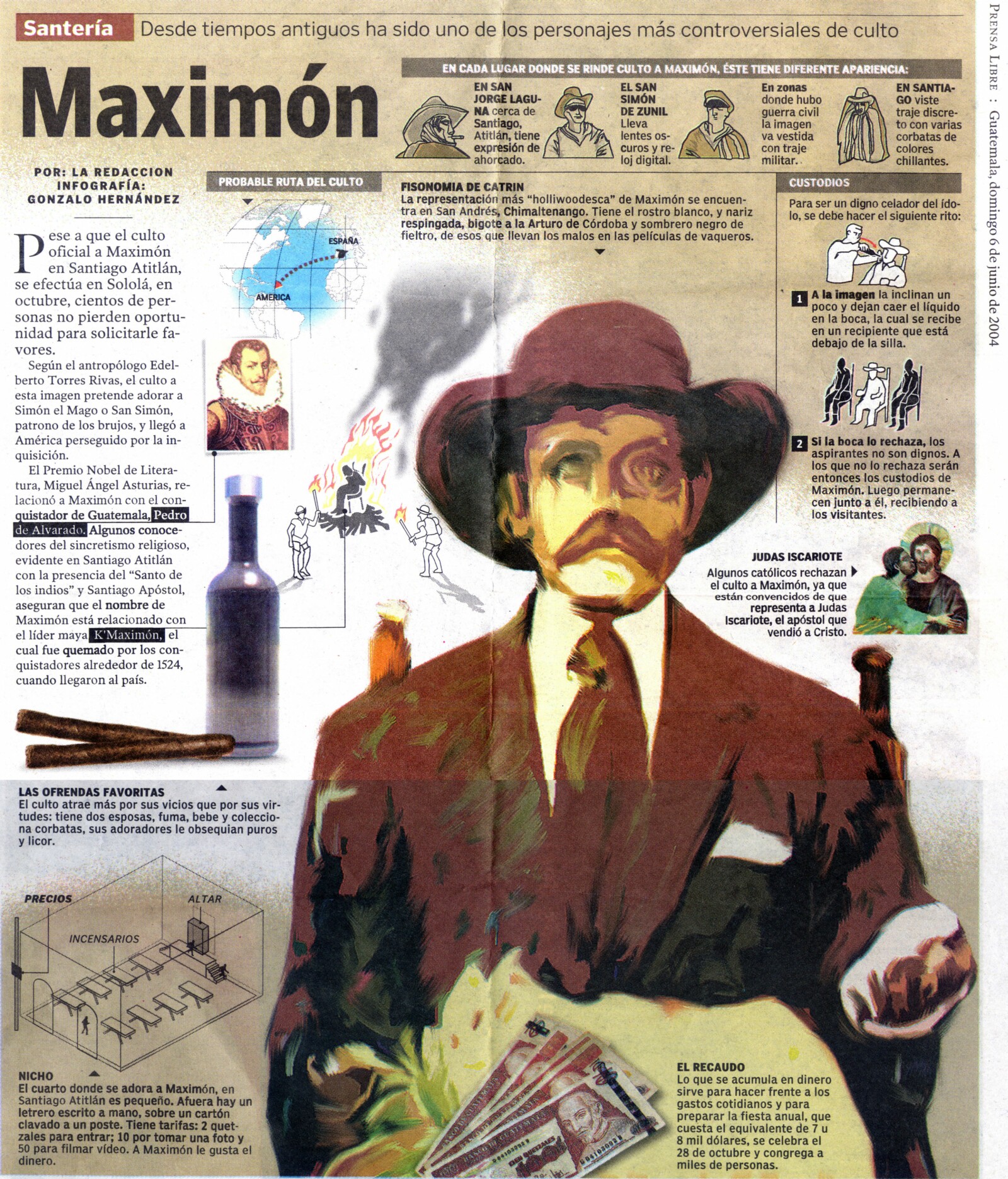
The San Pascualito theory is especially interesting because of another unofficial Latin American saint, Maximón, also known as San Simón. Maximón is a roguish entity worshipped in approximately 20 places in Guatemala. He is a pseudo-deification of the conquistador Pedro de Alvarado,[54] who seems to have been synchronized with the Mayan underworld deity, Maam,[55] or Rilaj Maam, who is the “most revered god of the Tzutuhil pantheon,”[56] and is found among Mayan descendants, notably the Quiches and Tzutuhiles of Guatemala. Like San Pascualito, he is associated, in particular, with Holy Week celebrations.[57] Like Santa Muerte, Maximón is worshipped by leaving offerings of candles, alcohol, tobacco, candy, or personal items.[58] Also like Santa Muerte, Maximón is a patron of people on the fringe of the society – in Maximón’s case, drunkards and gamblers.[59] Consequently, Maximón shares a similar geography and seasonal association with Santa Muerte’s likely progenitor as well as a similarity in method of worship and followers with Santa Muerte herself.

Figure 14 Shrine to Maximón[60] Regardless of how it may have originated, the cult has become a major phenomenon only recently. According to Blanquita Tamez, a practitioner of the cult from Monterrey, Nuevo León, her grandmother was a Santa Muerte devotee.[61] This suggests that the cult has been around since at least the mid-20th century. It spread more rapidly in Mexico during the mid-1960s.[62] It appeared in Hidalgo in 1965. It also established roots in Mexico State, Guerrero, Veracruz, Tamaulipas, Campeche, Morelos, Nuevo León, Chihuahua, and the Federal District, especially the barrio of Tepito.[63]
Although they are prima facie contradictory, the different accounts Santa Muerte’s history are still telling because what practitioners choose to believe about their cult’s history is in many ways as interesting as what its true origins may be. They also have certain themes in common. The cult is associated with indigenous peoples, blending Catholic and pagan beliefs. The cult is associated with people on the fringe of Mexican society – slaves, indigenous peoples, the poor, and criminals.

Figure 15 Aerial Photograph of Tepito Market[64] The Goddess of Tepito
Mexico City appears to be the hub of the Santa Muerte cult, with ten shrines. These include one shrine at 12 Alfarería Street (between Mineros Street and Panaderos Street), a shrine at the corner of Matamoros and Peralvillo Streets, another at Villa de Guadalupe in the Plaza del Peregrino, a fourth at 16 Canarias Street, another shrine at 352 Retrograbados Street in Colonia 20 de Noviembre, and a sixth at the Parrish of the Suffering and Sanctuary of Santa Muerte at 35 Bravo Street, Colonia Morelos.[65] There are reportedly at least four shrines at other locations in the city[66] and 120 altars where her figure is venerated.[67]
Within Mexico City itself, these shrines are concentrated within one particular neighborhood: Tepito. Tepito is not just any neighborhood, however. Also known as Tepis, Tepiscoloya, and Tepistock, Tepito is without doubt the most infamous barrio in Mexico. Its tough reputation dates back to pre-Hispanic times. The neighborhood market is the black market – knockoff goods, drugs, and weapons are sold openly on the street. The police are seen as unable to control the crime.[68] Indeed, it is in the poverty and desperation that her cult seems to thrive.[69] Thus, the very heart of the cult is a place associated with poverty, crime, and defiance.
Santa Muerte is not limited to Tepito, however. There are at least 35 different locations in Mexico where Santa Muerte is venerated and where her skeletal figure is paraded. There are also twelve locations where Santa Muerte pilgrimages take place.[70] Increasingly, the cult is appearing along the border, where it seems to have reached almost every town.[71] Such a spread, from the heart of Mexico City to various border communities, conveniently coincides with the routes of illegal immigration and drug trafficking.
The Lord of the Rings
The Santa Muerte cult appears to have little, if any, official organization. However, one personality is at the forefront of the cult. Monsignor David Romo Guillén, 47, AKA the Lord of the Rings (El Señor de los Anillos) is the Archbishop and Primate of the so-called Mexican-U.S. Catholic Apostolic Traditional Church (Católica Apostólica Tradicional México-USA AKA la Iglesia Católica Tradicionalista Mex-USA). Romo is a married father of five and a veteran of the Mexican Air Force, in which he claims to have served as an administrator. He is also the self-professed leader and guardian of the Santa Muerte cult. Since 2002, he has been leading masses at the National Sanctuary of Santa Muerte, located at Bravo 35 in the in Venustian Carranza delegation. Romo now boasts an attendance of 200-300 parishioners, mostly youths, at each mass. Many of these youths dress up in costumes for the occasion.[72] The masses are held at midnight.[73]
Figure 16 David Romo Guillén[74] Figure 17 A Worshipper inside the
Santa Muerte National Sanctuary[75] Figure 18 David Romo Guillén[76] “Approximately 80 or 90 people [visit] daily, coming with their families, alone, or with companions. Likewise, we have an attendance of 200 or 300 persons twice weekly,” states Romo.[77] He estimates that there are one million followers of Santa Muerte in Mexico.[78]
Romo is also an ardent defender of the cult. When José Guadalupe Martín Rábago, head of the Mexican Episcopal Conference (CEM) (Conferencia del Episcopado Mexicano), and Cardinal Norberto Rivera Carrera described the Santa Muerte Cult as Satanic, Romo filed a defamation complaint before the Public Ministry (Ministerio Público). Martín stated that he would request the Interior Secretariat (SEGOB) (Secretaría de Gobernación), headed by Interior Secretary (Secretario de Gobernación) Santiago Creel Miranda, to review the process of religious registration. Romo then stated that the devotion to Santa Muerte was not different from devotion to saints in other churches. He argued that Santa Muerte was a tool for evangelizing people in the marginalized sectors of society just as the Virgin of Guadalupe was a vehicle for converting Native Americans. At the time, SEGOB refused to intervene.[79]
In April 2005, however, despite a marches and protests by Santa Muerte adherents the previous month, SEGOB concluded in a 25-page resolution that the Santa Muerte Cult did not meet the qualifications for a religion and removed the Mexican-U.S. Catholic Apostolic Traditional Church from the list of recognized religions, citing theological doctrine dating back as far as the Council of Trent. Romo issued a call for Santa Muerte devotees to vote against Secretary Creel’s party, the National Action Party (PAN) (Partido Acción Nacional), and Creel himself in the 2006 Mexican Presidential Elections. Romo also began a series of meetings with Mexico City magistrates to promote social development and community service projects that would be undertaken by Santa Muerte adherents under the a new blanket organization, the National Association of Altars and Sanctuaries of Santa Muerte (Asociación Nacional de Altares y Santuarios de la Santa Muerte), which is effectively replacing the Mexican-U.S. Catholic Apostolic Traditional Church. The organization includes 100 of the 120 altars that display Santa Muerte in Mexico City.[80]
The irony in this conflict is that the very forces that initially sought to stamp out the cult seem to have had no effect on the numbers of people participating in it. However, the legal action has generated a large amount of press attention, which has offered legitimacy to Romo. Although there has been no historic guidance or central organization for the Santa Muerte cult, a sense of unity and order may be in the process of being established. Romo, who seems to have been little more than a leader of a local group, may become the effective leader.
Santa Muerte Witnesses Violent Crimes
In 2004, the Santa Muerte shrine itself was the scene of a violent crime. Eber Lazcano Cortes AKA El Eber, 23, of Tepito, considered himself to be an expert knife-fighter, having killed two people with a knife and injured a Federal Investigative Agency (AFI) (Agencia Federal de Investigaciones) officer in Colonia Morelos. He purportedly learned knife fighting during a three-year sentence at the Northern Prison, where he claims he had to “kill to survive.” On 20 October 2004, Lacanzo, who had been making a living by washing cars, got into an argument with another car-washer, by the name of David. David’s brother-in-law, Pedro Vélez Ledezma, tried to calm things down, but Lazcano turned on him. At that point, some of Vélez’ relatives got involved and beat up Lazcano. Lazcano left, but came back with four friends, chased Vélez down, and, while his friends held him by the neck, Lazcano stabbed Vélez in the chest, killing him, in front of the Santa Muerte Chapel. On 14 November 2004, Federal District Preventive Police (Policías preventivos del Distrito Federal) officers tracked down Lazcano and arrested him for homicide.[81]
This is not the only time that Santa Muerte has witnessed crime in front of her chapel. On 13 May 2005, unknown assailants in a grey Jeep Grand Cherokee chased a stolen white Audi driven by Oscar Alberto Garcia Angels AKA El Asesino [the Assassin], 25 and Oscar Adrian Gamboa Solis, 23, leaders of the gang Los Sapos, as well as another gang member named Raquel, 23. The chase occurred between Miguel Dominguez Street and Ferrocarril de Cintura Street in Tepito. During the pursuit, the occupants of the Jeep fired shots at the Audi. The Audi stopped at the Santa Muerte Chapel, where the Jeep’s occupants got out of their vehicle and continued firing, hitting Gamboa, in the head and chest and Garcia and Raquel in the neck. All three survived, but Raquel was later declared brain dead. Gamboa had been wanted for murder. The victims were allegedly involved in the killing of a rival cocaine trafficker; the attack was part of an ongoing gang war.[82]
In both of these cases, a chase led to the Santa Muerte Chapel, where the crimes occurred. In the first case, it is unclear whether the victim fled to the Santa Muerte shrine, whether the perpetrator chose the shrine as the place to commit the crime, or whether it was the coincidental end of the chase. In the second case, it appears that the victims, themselves criminals, deliberately went to the shrine – perhaps to seek protection or asylum, or at least a fortified position. This seems likely, considering the context of Santa Muerte worship, which has an “unspoken rule that at Santa Muerte’s shrine, worshippers pray in safety by day and by night….”[83]
According to Mexican author Homero Aridjis, “Santa Muerte not only protects (the criminals) from betrayal and ambush, but also can be an agent in their favor against enemies, causing them harm, or death.” She is a “virgin saint in the religion of crime.”[84] Aridjis’ recent novel, Santa Muerte, is a fictionalization of what he alleges are actual events. In it, he states that he first discovered the cult while attending a party attended by drug traffickers and corrupt government officials in the 1990s. He became fascinated with the cult, researched it, and wrote the novel.[85]
Despite their hopes, in both of the above cases, Santa Muerte’s shrine did not provide protection. However, other devotees claim that she has afforded them sanctuary. Salvador Cuellar, a 33-year-old mechanic, claims to have been threatened by people who wanted to kill him. Once he invoked Santa Muerte, this changed. “I believe in the Virgin and other saints,” said Cuellar. “But the one who has helped me more is the Santa Muerte.”[86]
Prisoners Pray to Santa Muerte
Convicted criminals also pray to Santa Muerte for help and protection. Eduardo Martinez, 22, was recently released from the Eastern Prison in the Federal District, where he had served two years during his trial for armed robbery. When he was down to four months remaining on his sentence, guards found “a 45 cm piece of iron in the shape of a knife” in his cell. Martinez, understanding that the punishment for possession of a contraband weapon was a sentence extension of six months, prayed to Santa Muerte, “I asked not to be given more time because I only had four months left. I said to her that I would offer her my skin, and that was going to be the first tattoo that there would be on my skin. Then, after five days, she freed me and I did not have any more punishment – I was totally acquitted. For me, it was a miracle.” His acquittal was not simply acquittal from the contraband possession charge – he seems to have been acquitted of the robbery for which he had been convicted. The authorities apologized. However, this was not his only charge. He also called upon Santa Muerte for assistance in another trial on a similar charge. He offered to abstain from drugs for two years and light two candles to Santa Muerte in each of her chapels. He credited her with two miracles, stating, “The Lord Jesus Christ is my only savior and the Virgin is his mother, but the only one certain is Santa Muerte.”[87]
Martínez is not alone in such sentiments. On 12 October 2003, 41 convicted drug traffickers, murderers, thieves, and rapists were granted early release from the Federal District’s East Prison (Reclusorio Oriente) for good behavior. One of those released was Jesús González Ochoa, 26, of Peralvillo and Libertad Streets, in Tepito. González had five previous convictions for robbing passersby. Unlike his fellow parolees, González had no one present to greet him. His family was unaware of, or uninterested in, his release. He had no money, but he kissed an amulet of Santa Muerte that he kept next to his heart. A stranger gave him 50 pesos to pay his way home. He used it to buy beer, stating, “Now, yes, I am free.”[88]
The Skeleton in the Family Closet Was Santa Muerte
Some Santa Muerte practitioners have taken their worship to the extreme. On 19 May 1999, Preventive Police arrested Inocencio García López, along with his wife, Luisa Martínez Aguilar, and his two sons, Raúl Paulino Martínez Aguilar and Raúl Ramírez Aguilar, for the murder of José Trinidad Silva Leyva and the wounding of Alfredo Lugos Olmedo in the city center of Tlaxiaco, Oaxaca, as part of an ongoing dispute. García was sentenced to 38 years incarceration; his wife and sons were each sentenced two 32½ years. In October 2004, García committed suicide by hanging himself in his cell. In a suicide note, he left financial information to cover the cost of his burial. He also accused his wife of having an affair with another prisoner and blamed this for his suicide. On the back of a photograph of his wife, taken when she was pregnant, he accused her of being culpable in the death of a certain Francisco Barragán Moreno. He also wrote a prayer to Santa Muerte, asking her to be with him in his suicide.[89]
García’s case is not the only one of a suicide linked to Santa Muerte. Javier Hernández Pacheco, a devotee of Santa Muerte, hanged himself from a tree in his patio while his four-year-old son watched. The suicide occurred on 13 July 2005, when his wife, Lilia Esperanza Murillo Santiago, left him and their four-year-old son, Didier Hernández Murillo, at their home in Colonia Leandor Valle in the municipality of Kanasín, Yucatán, while she went shopping for groceries. After returning home, she realized that she had forgotten something. She asked her husband to take Didier inside while she returned to the store to buy a soft drink. When she returned later, she saw her son standing in the doorway. He told her that his father was hanging in the patio. When she entered, she found her husband hanging from the clothesline. According to the boy, his father had asked him to wait in his room while he prayed to his Godmother [Madrina]. Didier went to his room but, hearing strange sounds from the patio, looked outside to see his father hang himself. Lilia stated that her husband had been acting strangely recently; she attributed his suicide to his Santa Muerte practices.[90]
Both of these suicides stand out as examples of how Santa Muerte can enable activities that are otherwise socially unacceptable. Since suicide is completely unacceptable in Christianity, no Catholic saint could be called upon for a blessing in such an act. With Santa Meurte, these individuals were able to find a spiritual being who would allow – and therefore possibly enable – their deaths. Such reasoning is easily transferable to other sinful and probably illegal acts.
Criminals Carry Accoutrements of Santa Muerte
If Santa Muerte is associated with one crime in particular, it seems to be kidnapping. An example of this occurred on 22 March 2005, when personnel from office of the Assistant Attorney General for Specialized Investigations into Organized Crime (SIEDO) (Subprocuraduría de Investigación Especializada en Delincuencia Organizada) and AFI in the Colonia La Nopalera, Iztapalapa Delegation, Mexico City, arrested six individuals that were allegedly involved in the kidnapping of a minor in Morelos. Among those arrested was businessman Francisco Miguel Cerqueda López AKA El Mickey, 33. Cerqueda was a resident of the San Rafael Atlixco Habitation Unit, Building B-9, Suite 101, in Colonia Zapotitlán, Tláhuac Delegation, Mexico City. He was identified as the gang’s leader. Also arrested was businessman Cruz Ramírez Sánchez AKA El Cruz, 28. Ramírez resided at 23 Arnulfo R. Gómez Street, in Colonia Caracol. He allegedly made telephone calls to victims’ families. Another arrested member of the gang was businessman Víctor Manuel Pérez Ibarra AKA El Chino, 32. He resided at Hidalgo Unit No. 10, Building 3-C, Suite 303, in the Azcapotzalco Delegation. Pérez guarded the victims. He also maintained a safe house at 5890 Tláhuac Avenue, in Colonia La Nopalera, Tláhuac Delegation. A fourth member of the gang was businessman Marcos Martínez Ruiz AKA El Tala, 29. He lived at 106 Ramos Millán Sur Street, in the Iztacalco Delegation. Like Pérez, Martínez guarded victims. He also directly participated in the kidnappings. The fifth arrested gang member was Gerardo de la Torre Guizado AKA El Gerad, 30, a blue-collar worker of an unspecified trade from 20 Galicia Street, in Colonia Cerro de la Estrella, Iztapalapa Delegation. He also guarded the victims. The final arrested member of the gang was janitor José Luis Palma Bermejo AKA El Pelón, 27. Palma lived at an unnumbered residence at Mar de las Crisis Street and Montes Apeninos Street, in Colonia Selene, Tláhuac Delegation. Palma was responsible for casing the victims. While carrying out the arrests, the agents also seized a red, 1993 Chevrolet Hunter pickup without license plates that was registered to Liliana Hernández Martínez, a grey Chevrolet Astro SUV without license plates, A 9mm Glock pistol with registration number MN656, 93 9mm rounds, $(USD) 73,740.00 cash, eight cellular telephones of various brands, and six identification credentials.
At one point, the operation was nearly interrupted by Federal District SSP officers. The Office of the Federal Attorney General (PGR) (Procuraduria General de la Republica) initially blamed the mistake on poor inter-agency coordination[91] and began an investigation. SIEDO personnel interrogated 70 Preventive Police (Policías Preventivos) Officers from the Federal District Public Safety Office (SSPDF) (Secretaría de Seguridad Pública del Distrito Federal). SIEDO was concerned about whether police had been providing protection to drug trafficking and kidnapping gangs, leading to conflict between the agencies.[92]

Figure 19 Martínez’ Tattoos Figure 20 Ramirez’ Tattoos The arrest report filed by the PGR included photographs of the arrestees. Most of these are standard mug shots with the word detenido [arrested] superimposed, which is frequently the procedure of the PGR Internet site. One of these photos shows a tattoo on Perez’ left shoulder blade, covering most of it. The tattoo is a large image of Death, covered in a shawl or hood, brandishing a scythe in what appears to be a threatening manner. Although the resolution is poor, it appears that there is a halo or crown around the head of Death, suggesting that it is very likely Santa Muerte. Other photos in the report show tattoos on Martinez and Ramirez. The images are of too low a resolution to be certain, but the tattoo on the upper left side of Martinez’ chest may also be a figure of Death holding a scythe.
In December 2004, Public Safety personnel conducted an operation at the intersection of Paseo de las Cañadas and Aztecas Streets in the Monraz housing estate in Guadalajara, Jalisco. The officers arrested José Gil Caro Quintero AKA José Luis Reyes Hernández, José Belem Mendoza Flores AKA José Delem Mendoza Flores, Francisco Rodríguez Ayala AKA Franciso Rodríguez Ayala, Paul Villa Araujo AKA Julio César Lazcano Salazar, and Óscar Meza Alvarado on drug trafficking charges. The five suspects were allegedly core members of the gang Los Norteños, which operated in Jalisco, Morelos, and Veracruz. At the time of their arrests, the alleged gang members were traveling aboard two vehicles: A black, armored 2002 BMW X5 with electric locks and door handles and a gray, 2005 Volvo XC90. At the scene, the arresting officers seized four Kenwood portable radios, a magazine pouch, four magazines, 22 7.62 caliber rounds, a Colt .22, a .45 and two .38 Specials. One of the .38 Specials was encrusted with a Santa Muerte figure in gold and gems.[93]
Julio César Cortazar, 26, and Jorge Oswaldo González Barra, 20, boarded a passenger bus at the intersection of Avenida de Tlalpan and Periférico, on the edge of the Tlalpan delegation of Mexico City, in February 2004. One of them drew a Titan .25 caliber pistol and demanded the passengers surrender their valuables. The two took the money, struck the driver, threatened the passengers, and fled the scene. One of the passengers flagged down nearby Federal Preventive Police (PFP) (Policía Federal Preventiva) officers, who pursued César and González to the intersection of Moctezuma and Fuentes streets, in the Toriello Guerra colonia. One of the suspects fired at the police officers with the pistol multiple times, but the officers managed to arrest the two. The police officers found cash, valuables, and identification belonging to the bus passengers. Both of the suspects exhibited tattoos of Santa Muerte on various parts of their bodies. They also wore rings and were carrying votive jewelry (dijes or milagros) depicting the Santa Muerte.[94]
Santa Muerte Has Following in Major Criminal Organizations
It is not mere street thugs who are practitioners of the Santa Muerte cult. At least two incidents associated with Osiel Cárdenas Guillén’s powerful Gulf Cartel have been crowned by the presence of Santa Muerte paraphernalia. The first incident occurred on 09 April 2001, when the Mexican Army raided a mansion in a Tamaulipas village. The residence belonged to Gilberto García Mena AKA El June, a Gulf Cartel cell leader who was fascinated by the mysterious and who mutilated his enemies. The soldiers arrested García when they found him hiding in a secret, underground chamber in the house. While searching the property, the agents discovered a hut in his garden, which served as a chapel. Inside, they found a stature of Santa Muerte surrounded by candles and offerings that García had given in hopes of power and protection.[95]
More recently, in August 2004, Mexican Army personnel raided a house located at 510 Montañas Rocallosas Street and Montes Cárpatos Street, in the Lomas de Virreyes colonia, a residential area of Mexico City. The house had been used by members of the Gulf Cartel as a laboratory to process cocaine before shipping the drug to Tamaulipas [and, presumably, on to the U.S.]. They had been renting the house for at least three months. There, amid posters of bikini-clad and nude women, computers, and various bottles of liquor, was an altar with several amulets to St. Jude as well as an amulet to Santa Muerte.[96]
A singular incident involving a Gulf Cartel member who happened to be a devotee of Santa Muerte would be interest but of little real concern. The appearance of cult items in separate incidents, one near the U.S. border and one in Mexico City, three years apart suggests that the cult may pervade the cartel.
In addition to the major drug cartels, the cult also seems to have reached the infamous Latin American youth gangs. On 27 March 2005, Milenio journalist Juan Dios Garcia Davish published an interview with Carlos Eduardo Pavon AKA El Cuervo, a Honduran citizen and a leader of the gang Mara Salvatrucha AKA MS-13. At the time of the interview, Pavon was incarcerated in the Tapachula State Prison in Tapachula, Chiapas. He had been arrested in December 2003. During the interview, Pavon accused the news media of publishing lies about Mara Salvatrucha. While carrying a wallet with the image of Santa Muerte, Pavon denied apparent allegations that his gang is Satanic, stating, “You are not satanic just because you leave a couple of candles lit. We only believe in God. No one else, not even in Our Lady of Guadalupe.” However, Pavon then laughed at the interviewer. He later revealed the tattoos on his back, which included a large “MS13”, male and female clown faces, the words “Satanic Member”, and a skeletal hand of death.[97]
In the interview, Pavon was not defending and commenting about himself. He was speaking about his gang cell and, probably, the Mara Salvatrucha as a whole. He used the word “we” when denying Satanic practices, implying that many or all of the gang members were accused of following allegedly Satanic rites – in this case, Santa Muerte. His denials were obviously facetious, however, because of his tattoo that plainly stated, “Satanic Member.” This is also probably the only case of a direct link between Santa Muerte practice and Satanism.
Perhaps the most infamous case involving Santa Muerte occurred on 18 August 1998. Agents of Mexico State’s Attorney General’s Office (PGJE) (Procuraduría General de Justicia del Estado de México), in coordination with personnel from the Anti-Terrorism Team and Center for Political Investigations and National Security (GAT-CISEN) (Grupo Antiterrorismo y Centro de Investigaciones Políticas y Seguridad Nacional) and the Federal Attorney General’s (PGR) (Procuraduría General de la Republica) Anti-Organized Crime Unit (Unidad Contra el Crimen Organizado), conducted operations in the municipalities of Tultepec and Naucalpan in Mexico State. During the operations, the officers arrested Daniel Arizmendi López AKA El Mochaorejas as well as members of his gang, including Rafael Arturo Dicante Rosales, Juan Ramón Frutos Aguilar, Ernesto Mendoza, Miguel Armando Morgan Hernández, Rafael Noguez Yañez, Raymundo Jiménez Hernández, Dulce Paz Vanegas, and Flor Camelia Vanegas Martínez.[98] Arizmendi was one of the most notorious and brutal kidnappers in Mexican history. He and his gang kidnapped 24 people, holding them for ransom while sending ransom notes to victims’ family members along with the victims’ severed ears, thereby receiving payments totaling over $(USD) 40 million.[99] During the operation, the arresting officers found Arizmendi hiding in his bathroom, where they also found an altar to Santa Muerte.[100] Arizmendi asked the arresting officers for permission to take the statue with him; they granted the request. He took the statue with him when he was remanded to the La Palma Maximum Security Prison.[101] Officers later learned that part of the gang’s routine was to offer supplications to Santa Muerte.[102]
Santa Muerte on the U.S. Border
Illegal migrants have been praying to Santa Muerte, carrying images of Santa Muerte in their clothing and giving thanks to her for their crossing.[103] It is through these illegal migrants that Santa Muerte seems to be spreading to the U.S.[104] The spread of the cult across the border was predicted by Homero Aridjis.[105]
In some ways, Santa Muerte is a logical choice of patron for would-be illegal migrants. Crossing the border is often dangerous, simply because of the terrain, and illegal migrants must consider the risk of death when preparing for their journeys. Furthermore, illegal migrants frequently come under the criminal influence if not guidance of human smugglers and drug traffickers. Finally, the action itself is by definition a crime, an action for which a person might not expect a traditional saint to offer protection.
Some criminals seem to treat Santa Muerte with a respect that they do not extend to other religious figures. According to the Mexican newspaper La Cronica, in the late 1990s, the family of Eugenio Hernández Vara financed the construction of a chapel to the Virgin of Guadalupe. The chapel was built eight kilometers from the town of Anáhuac, on the side of the highway leading to Nuevo Laredo. Hernández’ family had the chapel built to serve the pilgrims who frequently travel the road. The chapel was also used by local farmers, who used the chapel to pray for rain and good crops. Located nearby was an altar dedicated to Santa Muerte, who is believed to be venerated by drug traffickers that also use the road. In April 2004, unknown vandals destroyed the Chapel of the Virgin of Guadalupe. However, they left the Santa Muerte altar in pristine condition.[106]
The motive for the shrine desecration is unknown. It may have been perpetrated by Santa Muerte devotees. It may also have been a random act of vandalism. If the latter is the case, the fact that Santa Muerte was left untouched is a telling indicator of the nature of the cult. Unlike the Virgin of Guadalupe, who represents forgiveness, Santa Muerte is an entity associated with, among other things, revenge. The vandals may have feared incurring a curse or, at least, the vengeance of the drug traffickers and smugglers who adore Santa Muerte.
The location of the shrine is also telling. Anáhuac is not a major metropolitan area but it is located on one of only three major highways leading into Nuevo Laredo, Tamaulipas. Nuevo Laredo is one of the most notorious cities on the U.S. border. It is situated across the border from Laredo, Texas, which is the starting point of Interstate 35 – the major north-south corridor leading into the United States. This geography makes it a natural chokepoint for overland shipping between the two countries, a fact evinced by a high-volume of truck traffic through the Nuevo Laredo Ports of Entry. Consequently, it is a strategic location for smuggling, which contributes to the high-levels of crime and violence in the region. The Santa Muerte shrine is, therefore, conveniently situated to serve the needs of smugglers and other criminals about to cross the border. It is also a convenient location for smugglers to offer dedications of thanksgiving after crossing into Mexico.
The Patron Saint of Crime
People give numerous reasons for giving offerings to Santa Muerte. Some still consider themselves Catholic. Some say that they are disillusioned with traditional Catholicism. Others say that Santa Muerte has granted miracles and favors that other saints have not.[107] Still others claim that they find Santa Muerte more welcoming because she does not distinguish between good and evil practitioners.[108]
Increasingly, many of the devotees of Santa Muerte are being described as ordinary, working-class people, rather than the criminals with which the cult has traditionally been associated. Among those would be taxi driver Mario Juarez, claiming that Santa Muerte offered “a little more protection” in rough neighborhoods.[109] Carmen González Hernández, a grandmother from Tepito, prayed to Santa Muerte for help raising her grandchildren, whose father was in prison. Hayde Solís Cárdenas, prayed to Santa Muerte for help running her business after her son left, abandoning her grandson with her. She worked with loan sharks and smugglers, selling stolen tennis shoes.[110] Isiel Alvarado, a welder, prayed to Santa Muerte for delivering his brother from prison. Subway janitor Maria Carrillo, prayed to Santa Muerte for help raising her four grandchildren, abandoned by their mother, who ran away. At the ages of seven and nine, respectively, Marisa Adriana Ruiz and Carla Patricia Reyes prayed to Santa Muerte for the release of their fathers from prison. Gonzalo Urbano prayed to Santa Muerte because he believed she restored his son’s vision.[111]
Although not all of these individuals are criminals themselves, it would be misleading to describe them as independent of crime. In most cases, they are still people whose lives are touched, if not dominated by crime. Although not crimes of their own, the crimes are committed by family members, neighbors, or people with whom they interact daily.
Conclusion
Because its practitioners do not seem to seek any spiritual enlightenment, simply favors and rewards, the cult of Santa Muerte is probably best described as not so much a religion as an esoteric practice wrapped in the trappings of a religious movement. Although it may have been around for a considerable time, it appears to have been spreading more rapidly, particularly within the last decade. Efforts to truncate its growth may actually be encouraging it. It has historically been diffused but is becoming increasingly organized, especially in Mexico City.
Tepito has been and will likely continue to be the center of the organized cult. It is growing throughout other parts of Mexico, particularly at the U.S border. It appears to command respect and have considerable influence upon its practitioners.
The Santa Muerte cult is anti-establishment and appears to glorify criminal behavior. Although not all members of the cult are criminals, all live an existence that is dominated by crime. The cult seems to be linked closely to prisons, prisoners, and family members of prisoners. It is also associated with at least two organized criminal groups – the Gulf Cartel and the Mara Salvatrucha. Although it does not appear that most practitioners would commit crimes on behalf of the cult, some criminals might use it as an impetus to commit a crime or to increase the scale and violence of their crimes. Furthermore, because of the inherent danger in crime, the invocation of death itself as patron has a manifest appeal.
The website of a Santa Muerte practitioner describes the Santa Muerte as, “a symbol that identifies people who live between the legal and the illegal, but it can also be found in high levels of society.”[112] It is a veritable embodiment of the sense of dissatisfaction, exclusion, isolation, and despair among the marginalized in Mexican society. As long as these appear to be conditions of life in Mexico and Latin America and among Latin American communities in the U.S., the cult of Santa Muerte will almost certainly continue to prosper.
[4] “Saint Death Offers Mexicans Solace”, Taipei Times, 15 May 2004, http://www.taipeitimes.com/News/world/archives/2004/05/15/2003155572 22 July 2005;
Diego Cevallos, “‘Saint Death’ Sought for Blessing in Endless War”, Inter Press Service Asia-Pacific, 06 February 2004, http://www.ipsnews.co.th/anmviewer.asp?a=1382&z=94&faces=1 22 July 2005;
Nadia Tate, “Paying Tribute to Death”, amcham.com, May 2004, http://www.amcham.com.mx/hotissues/20mayo/tribute.html 22 July 2005.
Reed Johnson with Froylan Encisco, “A ‘Saint’ of Last Resort”, Los Angeles Times, 24 March 2004, http://www.lioncity.net/buddhism/index.php?showtopic=3851 and http://freejesus.net/home/viewtopic.php?t=3885 22 July 2005.
[5] Elizabeth Carmichael and Chloë Sayer, The Skeleton at the Feast: The Day of the Dead in Mexico (Austin: University of Texas Press in cooperation with British Museum Press, 1991) 58-71.
[9] Eduardo López Loyola, “La Santa Muerte vive en México” [Santa Muerte Lives in Mexico], Univision Online, 30 July 2003, http://www.univision.com/content/content.jhtml?cid=242599#1 22 July 2005;
“Falsos ‘Santos’” [False “Saints”], Bienaventuranzas.net, 2005, http://www.bienaventuranzas.net/ensenanzas/santos/falsos_santos.html 22 July 2005.
Juan Ambrosio, La Santa Muerte Biografía y Culto: Ventiséis rituals personales para consequir salud, dinero y amor [Santa Muerte Biography and Cult: Twenty-Six Personal Rituals to Obtain Health, Money, and Love], (Mexico City: Martínez Roca México, 2003) 109.
[15] Juan Ambrosio, La Santa Muerte Biografía y Culto: Ventiséis rituals personales para consequir salud, dinero y amor [Santa Muerte Biography and Cult: Twenty-Six Personal Rituals to Obtain Health, Money, and Love], (Mexico City: Martínez Roca México, 2003) 5-15.
[22] Enrique Francisco Aguirre Morales, La Santa Muerte, 2005, http://mx.geocities.com/e_franciscomx/LaSantaMuerte.html 22 July 2005.
Alfredo Magaña, “Santa Muerte, ‘Protectora’ de Criminales”, 30 May 2003, http://www.lacrisis.com.mx/delincuentes300503.htm 22 July 2005;
Ricardo Pacheco Colín, “El culto a la Santa Muerte llega a Los Angeles y Sudamérica” [The cult of Santa Muerte Arrives in Los Angeles and South America], La Cronica de Hoy, 15 August 2004, http://www.cronica.com.mx/nota.php?idc=139132 22 July 2005;
Mariana Castro Duarte, “Adoran la Muerte” [The Adore Death], Periódico a.m., 11 September 2004, http://www.am.com.mx/nota.asp?ID=41517 22 July 2005.
[34] Juan Ambrosio, La Santa Muerte Biografía y Culto: Ventiséis rituals personales para consequir salud, dinero y amor [Santa Muerte Biography and Cult: Twenty-Six Personal Rituals to Obtain Health, Money, and Love], (Mexico City: Martínez Roca México, 2003) 67-71.
[35] Juan Ambrosio, La Santa Muerte Biografía y Culto: Ventiséis rituals personales para consequir salud, dinero y amor [Santa Muerte Biography and Cult: Twenty-Six Personal Rituals to Obtain Health, Money, and Love], (Mexico City: Martínez Roca México, 2003) 67-71
[36] Enrique Francisco Aguirre Morales, La Santa Muerte, 2005, http://mx.geocities.com/e_franciscomx/LaSantaMuerte.html 22 July 2005;
Juan Ambrosio, La Santa Muerte Biografía y Culto: Ventiséis rituals personales para consequir salud, dinero y amor [Santa Muerte Biography and Cult: Twenty-Six Personal Rituals to Obtain Health, Money, and Love], (Mexico City: Martínez Roca México, 2003) 67-71.
[41] Jorge Luis Zarazúa Campa, “El Culto a la Santa Muerte” [The Cult of Santa Muerte], Periodismocatólico.com, 22 October 2003, http://www.periodismocatolico.com/archivo/b031022/06.htm 22 July 2005.
For discussion of Mictlán, Mictlantecuhtli, and Mictecacíhuatl, see Elizabeth Carmichael and Chloë Sayer, The Skeleton at the Feast: The Day of the Dead in Mexico (Austin: University of Texas Press in cooperation with British Museum Press, 1991) 25-35.
Juan Ambrosio, La Santa Muerte Biografía y Culto: Ventiséis rituals personales para consequir salud, dinero y amor [Santa Muerte Biography and Cult: Twenty-Six Personal Rituals to Obtain Health, Money, and Love], (Mexico City: Martínez Roca México, 2003) 5-15.
[43] “Mictlantecuhtli from Museo del Templo Mayor, Instituto Nacional de Antropología e História, México”, [Mictlantecuhtli, from the Major Temple Museum, Mexican National Institute of Anthropology and History], Arizona State University Department of Archaeology, 14 January 1998, http://archaeology.asu.edu/tm/pages2/mtm22.htm 22 July 2005
[46] Jorge Luis Zarazúa Campa, “El Culto a la Santa Muerte” [The Cult of Santa Muerte], Periodismocatólico.com, 22 October 2003, http://www.periodismocatolico.com/archivo/b031022/06.htm 22 July 2005;
Juan Ambrosio, La Santa Muerte Biografía y Culto: Ventiséis rituals personales para consequir salud, dinero y amor [Santa Muerte Biography and Cult: Twenty-Six Personal Rituals to Obtain Health, Money, and Love], (Mexico City: Martínez Roca México, 2003) 5-15.
[48] “Alternative Religion Profiles: Palo Mayombe”, Altreligion.about.com, 2005, http://altreligion.about.com/library/faqs/bl_palo.htm 22 July 2005;
Juan Ambrosio, La Santa Muerte Biografía y Culto: Ventiséis rituals personales para consequir salud, dinero y amor [Santa Muerte Biography and Cult: Twenty-Six Personal Rituals to Obtain Health, Money, and Love], (Mexico City: Martínez Roca México, 2003) 5-15.
[49] Jorge Luis Zarazúa Campa, “El Culto a la Santa Muerte” [The Cult of Santa Muerte], Periodismocatólico.com, 22 October 2003, http://www.periodismocatolico.com/archivo/b031022/06.htm 22 July 2005;
Juan Ambrosio, La Santa Muerte Biografía y Culto: Ventiséis rituals personales para consequir salud, dinero y amor [Santa Muerte Biography and Cult: Twenty-Six Personal Rituals to Obtain Health, Money, and Love], (Mexico City: Martínez Roca México, 2003) 5-15.
[58] “Maximón”, Prense Libre, 06 June 2004, http://timshome.com/maximon/Maximon_articulo.jpg 04 August 2005; “Maximon”, Sapper Construction Company, 27 October 1999, http://www.sapper.com/maximon.html 04 August 2005; “Maximon”, Maya World, 02 February 2004, http://webs.lanset.com/bookfolk/mayan/maximon.htm 04 August 2005; Tim Hilliard, An Online Santuario to Maximón, June 2005, http://timshome.com/maximon/default.htm#Introduction 04 August 2005; Enrique Francisco Aguirre Morales, La Santa Muerte, 2005, http://mx.geocities.com/e_franciscomx/LaSantaMuerte.html 22 July 2005; Juan Ambrosio, La Santa Muerte Biografía y Culto: Ventiséis rituals personales para consequir salud, dinero y amor [Santa Muerte Biography and Cult: Twenty-Six Personal Rituals to Obtain Health, Money, and Love], (Mexico City: Martínez Roca México, 2003) 67-71.
[65] Ricardo Pacheco Colín, “El culto a la Santa Muerte llega a Los Angeles y Sudamérica” [The cult of Santa Muerte Arrives in Los Angeles and South America], La Cronica de Hoy, 15 August 2004, http://www.cronica.com.mx/nota.php?idc=139132 22 July 2005.
[94] “Asegura elementos de inteligencia de la PFP a dos presuntos Asantes, tras evader disparos” [“PFP Intelligence Personnel Arrest Two Alleged Assailants, after Avoiding Gunshots”], SSP Boletín de Prensa 037/04 [SSP Press Release 037/04], 14 February 2004, http://www.ssp.gob.mx/application?pageid=pfp_sub_2&docId=1593 23 September 2004.
[95] Sergio González Rodríguez, Huesos en el Desierto [Bones in the Desert] in Ricardo Pacheco Colín, “El culto a la Santa Muerte pasa de Tepito a Coyoacán y la Condesa” [The Cult of Santa Muerte Passes from Tepito to Coyoacán and Condesa], La Cronica de Hoy, 15 March 2004, http://www.cronica.com.mx/nota.php?idc=114661 22 July 2005;
“Personal Militar en Apoyo de la Procuraduría General de la Republica, Captura a Gilberto García Mena (a) ‘El June’” [Military Personnel Supporting the Federal Attorney General Arrest Gilberto García Mena AKA El June], SEDENA Press Bulletin, 09 April 2001, http://www.sedena.gob.mx/comunicados/2001/abril/c105.htm 22 July 2005;
Sergio González Rodríguez “La subcultura del narco: La santísima veleidosa” [The Drug Trafficker’s Subculture: The Capricious Saint], Reforma, 28 October 2001, http://busquedas.gruporeforma.com/utilerias/imdservicios3W.DLL?JSearchformatS&file=MEX/REFORM01/00198/00198220.htm&palabra=santa%20muerte&sitereforma 22 July 2005.
David Casas, “Indignación porque queman una capilla Guadalupana y no de la Santa Muerte” [Indignation because Guadalupe Shrine is Burned but Santa Muerte Shrine is Not], La Cronica de Hoy, 11 April 2004, http://www.cronica.com.mx/nota.php?idc=119082 22 July 2005.
[97] Juan de Dios García Davish, “‘Mara Salvatrucha’ Impone el terror en el tráfico de inmigrantes” [“Mara Salvatrucha” Puts the Terror into the Trafficking of Migrants], La Prensa, 10 April 2005, http://www-ni.laprensa.com.ni/archivo/2005/abril/10/nacionales/nacionales-20050410-02.html 22 July 2005;
Juan de Dios García Davish, “Mara Salvatrucha Head Says Group Seeks To Control Alien Smuggling” Milenio Semana, 27 March 2005, translated by FBIS [Milenio Semanal LAP20050405000020 Mexico City Milenio Semanal (Internet Version-WWW) in Spanish 27 Mar 05]
[102] Sergio González Rodríguez, Huesos en el Desierto [Bones in the Desert] in Ricardo Pacheco Colín, “El culto a la Santa Muerte pasa de Tepito a Coyoacán y la Condesa” [The Cult of Santa Muerte Passes from Tepito to Coyoacán and Condesa], La Cronica de Hoy, 15 March 2004, http://www.cronica.com.mx/nota.php?idc=114661 22 July 2005.
[106] David Casas, “Indignación porque queman una capilla Guadalupana y no de la Santa Muerte” [Indignation because Guadalupe Shrine is Burned but Santa Muerte Shrine is Not], La Cronica de Hoy, 11 April 2004, http://www.cronica.com.mx/nota.php?idc=119082 22 July 2005.


 Posts
Posts